
Automated Claude Code /goal maintenance
OpenFace can turn a Forgejo Issue addressed to @glm-maintainer into a verified, automatically merged Pull Request by running Claude Code's built-in /goal command against the cloned repository. Claude Code connects directly to Z.AI's Anthropic-compatible endpoint and uses glm-5.2.
Entry points at a glance
Four entry points share the same specialist, evidence, independent-review, and fail-closed merge gates. Questions are the deliberate exception: they stay read-only and receive an evidence-backed Japanese answer instead of a PR.
Flow
- Forgejo signs and sends the organization
push,issues,issue_comment,pull_request, orpull_request_commentwebhook. maintenance-agentvalidates the HMAC signature and records the delivery in PostgreSQL.glm-maintainerclassifies the request and posts a visible@specialistdelegation comment.- Only after that comment succeeds, the service clones the repository and creates
agent/issue-N. - Claude Code 2.1.205 receives
/goalfollowed by the Issue, the selected specialist contract, and explicit completion conditions. - Claude Code inspects local instructions and source, edits any required repository files, runs relevant commands and tests, reviews its diff, and keeps working until the goal evaluator finishes.
- The root wrapper verifies repository containment, required UI evidence, and
git diff --check. The specialist identity commits, pushes, and posts the completion reply with statusindependent review pending. glm-maintainervisibly mentions@review-agentwith the PR URL and review contract.- A second Claude Code
/goalrun checks the exact PR head SHA read-only. It traces every Issue requirement, reads the full diff, reruns relevant checks, records severity/location/remediation for findings, and emits anapprovedorrejectedreport. - UI/app reviews must independently start and operate the app and attach reviewer-owned mobile and desktop captures. The implementer's screenshots alone cannot satisfy this gate.
- Only a schema-valid approval for the unchanged head SHA permits server-side merge. The merge request also supplies Forgejo's
head_commit_id; rejection, missing evidence, reviewer edits, timeout, stale SHA, or merge conflict leaves the PR open.
This is deliberately not a fixed planner/coder JSON pipeline. There is no file-count or changed-line cap; /goal retains Claude Code's repository-level freedom.
Configure Z.AI
Keep the Z.AI API key in a protected env file outside the repository. Compose reads that file at container creation; the credential is never committed to Git.
ZAI_AGENT_CONFIG=C:/Users/you/AppData/Local/OpenFace/zai.env
ZAI_ANTHROPIC_BASE_URL=https://api.z.ai/api/anthropic
MAINTENANCE_MODEL=glm-5.2
MAINTENANCE_GOAL_TIMEOUT_SECONDS=3600
MAINTENANCE_MAX_WORKERS=2
MAINTENANCE_AUTO_MERGE=true
MAINTENANCE_HUMANLESS_ENABLED=false
MAINTENANCE_HUMANLESS_TOPIC=humanless
MAINTENANCE_HUMANLESS_SCAN_SECONDS=300
MAINTENANCE_HUMANLESS_INTERVAL_MINUTES=1440
MAINTENANCE_HUMANLESS_RETRY_MINUTES=60
MAINTENANCE_HUMANLESS_MAX_ATTEMPTS=3
MAINTENANCE_HUMANLESS_STALE_SECONDS=900
MAINTENANCE_AUTO_ISSUE_ENABLED=true
MAINTENANCE_AUTO_ISSUE_TOPIC=humanless-issues
MAINTENANCE_AUTOMATIC_RETRY_MAX_ATTEMPTS=3
MAINTENANCE_AUTO_LABEL_ENABLED=true
MAINTENANCE_AUTO_LABEL_DRY_RUN=false
MAINTENANCE_AUTO_LABEL_ALLOWED=bug,enhancement,documentation,question,good first issue
MAINTENANCE_AUTO_LABEL_CONFIDENCE=0.85
Then rebuild the idempotent seed and service:
docker compose up -d --build seed
docker compose up -d --build maintenance-agent
docker compose exec maintenance-agent claude --version
docker compose exec maintenance-agent python -c "import urllib.request; print(urllib.request.urlopen('http://localhost:8010/health').read().decode())"
The seed creates the non-admin orchestrator and specialist users, their write-only organization team, separate Forgejo tokens, a random webhook HMAC secret, and the push/Issue/Pull Request/comment webhook.
Automatic Issue and Pull Request labels
The signed webhook also classifies newly opened or edited Issues and Pull Requests. Classification is deterministic, so the same title, body, and PR file list always produce the same confidence and reason.
- only labels in
MAINTENANCE_AUTO_LABEL_ALLOWEDare considered; - a label must already exist in the target repository;
- existing manual labels are never removed or replaced;
MAINTENANCE_AUTO_LABEL_CONFIDENCErejects weak matches;- repeated deliveries are idempotent, and label-generated webhook events are ignored;
- every decision is stored in PostgreSQL and exposed by
GET /api/labels/audits.
Use the preview endpoint before enabling writes:
curl.exe -X POST http://localhost:8010/api/labels/preview `
  -H "Content-Type: application/json" `
  -d '{"title":"README is unclear","body":"Please document the setup.","changed_files":[]}'
Set MAINTENANCE_AUTO_LABEL_DRY_RUN=true to keep the same webhook and audit flow while returning would_apply without changing Forgejo. Set MAINTENANCE_AUTO_LABEL_ENABLED=false to stop classification completely. Rules initially cover bug, enhancement, documentation, question, and an explicitly beginner-friendly good first issue.
Trigger and opt out
Mention @glm-maintainer in a newly opened Issue to start maintenance. Users do not address specialists directly; the maintainer owns classification and delegation.
For unattended intake, set MAINTENANCE_AUTO_ISSUE_ENABLED=true and add either the humanless-issues or humanless repository topic. A new Issue then follows one of two fail-safe paths without a mention:
- a bug, regression, or vulnerability is assigned to the matching specialist, fixed on
agent/issue-N, independently reviewed at the exact SHA, and auto-merged only after approval; - a question, inquiry, support request, or unclassified report is investigated read-only. The specialist posts a Japanese answer with repository paths and confidence, and the wrapper rejects the run if tracked files changed.
When a bug-fix review is rejected or an automatic run hits a transient execution failure, the work returns to the same specialist and existing PR automatically. The specialist can update and re-review that PR up to MAINTENANCE_AUTOMATIC_RETRY_MAX_ATTEMPTS; reaching the limit leaves the PR open and the job inspectably failed instead of looping.
humanless-paused suspends unattended intake and scheduled maintenance. Add either opt-out marker when automation is inappropriate:
- label:
agent:skip - body marker:
<!-- openface-maintenance:skip -->
Repeated deliveries produce one job and one PR per Issue. The stable branch is agent/issue-N.
Issue-to-merge sequence
Humanless mode
Humanless mode replaces the human-authored Issue with a PostgreSQL-backed scheduler while preserving the same specialist, evidence, independent-review, and guarded-merge gates.
- Set
MAINTENANCE_HUMANLESS_ENABLED=true. - Add the
humanlessrepository topic. Addhumanless-uiwhen real browser evidence is mandatory. - On the first scan,
glm-maintainercreates a bootstrap Issue from the repository description, README, and existing files. coding-agentcompletes an actually usable first product. A separatereview-agentreviews the exact head SHA beforeglm-maintainercan merge.- After the configured interval, maintenance cycles rotate through design, security, documentation, and coding. Each cycle selects and completes one highest-value improvement from the current repository state.
- A rejected review automatically returns its findings to the same specialist and PR, up to
MAINTENANCE_HUMANLESS_MAX_ATTEMPTS. - Exhausted, stale, conflicting, or failed work remains fail-closed and becomes input to a later recovery cycle. It is never silently reported as complete.
Only one cycle per repository can be preparing, queued, running, or retrying. The humanless_cycles PostgreSQL table survives restarts and records the phase, specialist, Issue, attempt, state, PR, and next eligible run. An active worker renews its lease every minute; if the service disappears and no heartbeat arrives for MAINTENANCE_HUMANLESS_STALE_SECONDS, the next scan marks that lease failed. Before creating new work, recovery checks both PostgreSQL and Forgejo for the newest open agent/humanless-* PR newer than the last completed cycle. It supersedes later abandoned cycles and resumes that exact branch at independent review. If review rejects it, the same specialist edits the same PR; if review infrastructure stops, the next scan retries review without rebuilding the product. Add humanless-paused to suspend future cycles without deleting evidence. Inspect state at GET /api/humanless/cycles.
See the production humanless-autopilot evidence for completed cycles, the duplicate-cycle regression, a fail-closed review, Docker proof, and public browser captures.
All agent-invoked test, lint, build, and preview commands are instructed to use a finite command timeout. The wrapper also applies a process-group timeout to the complete Claude run and terminates descendant preview or test processes on exit. A hung command therefore becomes inspectable failed work rather than holding a repository lease forever.
Release branch push audits
A push to release, release-*, or release/* starts two isolated jobs without requiring an Issue mention:
| Agent | Required release inspection | Output |
|---|---|---|
security-agent | Full default-branch-to-release diff; authn/authz, validation, secrets, dependencies, CI/container boundaries, and supply chain | Security fixes when needed plus an evidence-backed docs/release-audits/ report |
docs-agent | README/VitePress, examples, migration and reconstruction steps, release-facing behavior, links, commands, actual diff, changed files, and tag history | Documentation fixes, diff-backed RELEASE_NOTES.md, versioned pages for every existing locale, and an evidence-backed docs/release-audits/ report |
The maintainer creates one visible audit Issue per agent and runs both jobs within MAINTENANCE_MAX_WORKERS. Their deterministic branches include the agent, normalized release branch, and pushed SHA. Each PR targets the pushed release branch—not the default branch. PostgreSQL deduplicates repository + branch + SHA + agent so webhook retries do not create duplicate work. Agent-authored pushes and release-branch deletion events are ignored.
Every release audit receives the separate, SHA-bound review-agent gate. Release notes cannot claim checks that were not run or infer shipped behavior from commit subjects alone. A rejected implementation is returned to the same agent and PR for at most MAINTENANCE_AUTOMATIC_RETRY_MAX_ATTEMPTS total attempts. With MAINTENANCE_AUTO_MERGE=true, glm-maintainer merges only a PR whose exact current head SHA is approved with every requirement and check passed and no findings. Exhausted, stale, conflicting, or incomplete reviews remain open. Inspect persisted release state at GET /api/releases/audits.
Bounded retry and loop safety
Continue editing from a comment
On the source Issue or its agent-created PR, mention the maintainer followed by the additional instruction:
@glm-maintainer 見出しも日本語にしてください。ほかのファイルは変更しないでください。The agent checks out the existing agent/issue-N branch, runs the Japanese completion prompt, verifies the new diff, and pushes a new commit to the same PR. Ordinary discussion comments do not trigger a model run. A currently queued or running Issue cannot be queued again; edit or post the follow-up after the active run finishes.
Maintainer-led specialist delegation
New Issues and follow-up comments are classified automatically by glm-maintainer. Direct @designer-agent, @coding-agent, @docs-agent, @security-agent, or @review-agent mentions do not start a run and do not override routing. The maintainer selects one specialist, announces that assignment in the conversation, and only then submits that specialist's worker. /api/agents lists the persona contracts, while /api/jobs records the selected username and job state. A PR-triggered job keeps the source Issue branch but posts reactions and the completion reply back to the PR conversation where it was requested.
The coordinator and five specialists are independent Forgejo users. Seed assigns each account its own least-privilege token and a separately generated, centered character avatar on a plain role color. Before a worker can start, glm-maintainer must successfully post a comment that mentions the selected specialist. If that announcement fails, the queued database reservation is removed and no hidden specialist run starts. The retained Issue #21 demonstrates this ordered hand-off through completion; profile and discussion screenshots are kept in docs/evidence/agents.
The Issue reaction trail is intentionally small: 👍 for human support, 👀 while the maintenance agent is working, 🚀 after successful publication, and 😕 when a run fails or stops before publication.
UI and application evidence gate
UI/app work cannot auto-merge from code inspection alone. The specialist must start the real app, exercise the changed interaction, and produce .openface-maintenance/ui-report.json plus real PNG captures. The wrapper requires all listed tests to be passed, at least one mobile capture at 480px or below, and at least one desktop capture at 1024px or above. It validates PNG signatures and dimensions, removes the private evidence directory from the commit, uploads the files to the Forgejo completion comment, and renders a Markdown table describing exactly what was tested. The maintenance image includes Chromium, Japanese CJK fonts, and color emoji so Japanese screenshots remain readable.
That implementer report is not approval. After the PR is pushed, glm-maintainer assigns @review-agent. The reviewer uses a distinct Forgejo token and a read-only prompt, validates the exact current head SHA, and writes .openface-maintenance/review-report.json. Approval requires every requirement and executed check to pass and the findings list to be empty. For UI work, the reviewer must independently capture at least one real PNG at 480px or below and one at 1024px or above; those images are uploaded from the reviewer account. A malformed report, missing image, changed tracked file, failed check, any finding, or stale head SHA blocks merge.
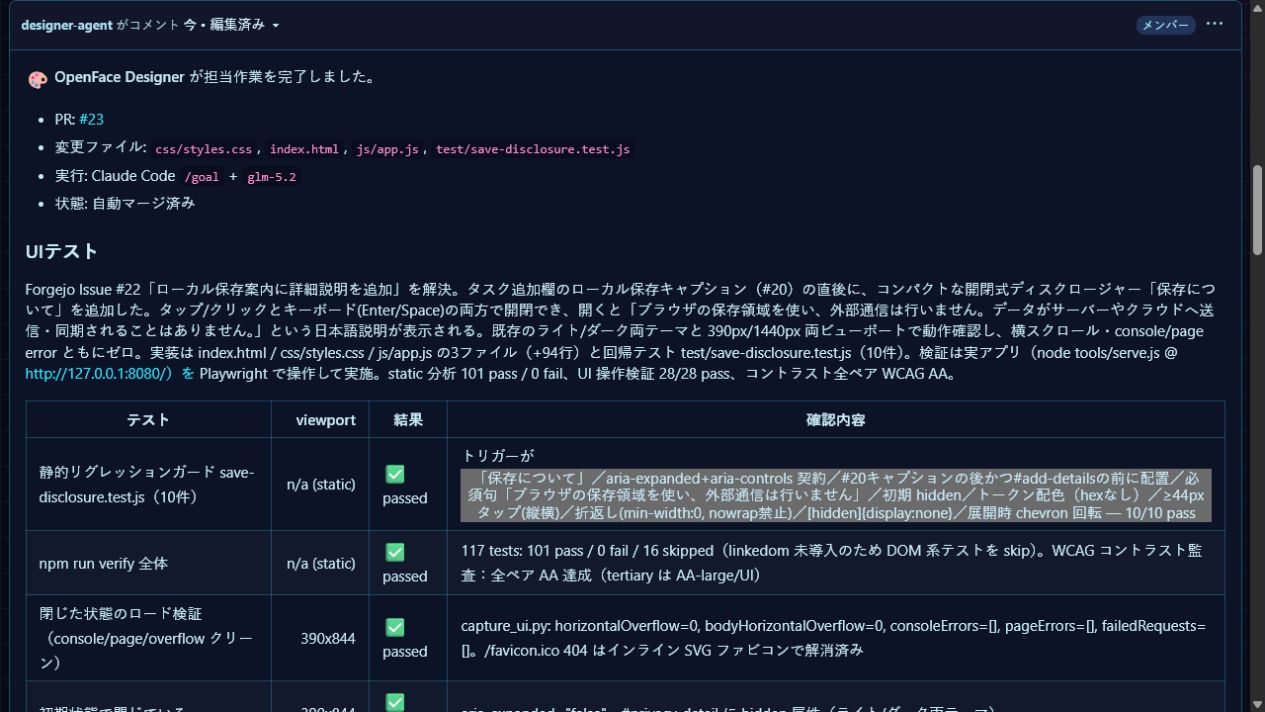
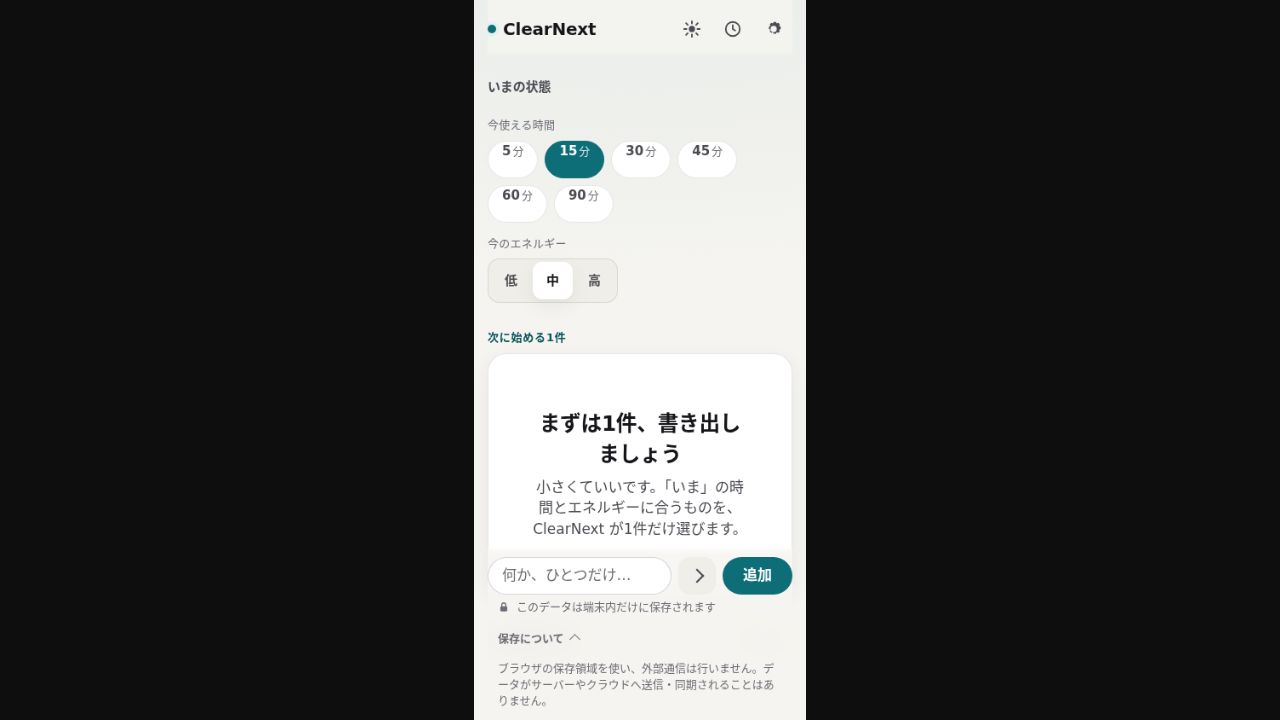
The retained ClearNext Issue #22 demonstrates the complete contract: human @glm-maintainer request, maintainer-to-designer hand-off, real disclosure interaction, mobile/desktop evidence, explicit overflow and browser-error checks, and verified auto-merge.
| Forgejo completion comment | Opened mobile attachment |
|---|---|
 |  |
Up to MAINTENANCE_MAX_WORKERS Issues run concurrently. Each job has its own clone and agent/issue-N branch; overlapping edits can still produce normal Git conflicts between the resulting PRs. Values are bounded to 1–4 to avoid exhausting the host or the model provider.
Freedom and isolation
- Claude Code runs as the unprivileged
maintaineruser inside the dedicated maintenance container. - The cloned repository is writable and normal Claude Code tools, local instructions, builds, tests, and linters are available.
- The container has no host Docker socket, so repository commands cannot control the host Docker daemon.
- Forgejo bot credentials and the webhook secret are root-only (
0600) and unreadable by Claude Code. - The model API credential is necessarily available to the Claude Code process for inference.
- The wrapper rejects paths that resolve outside the clone and requires
git diff --checkbefore publication. - Only the root wrapper receives Forgejo authentication for commit publication. Claude Code is instructed not to push or open PRs.
- With
MAINTENANCE_AUTO_MERGE=true(the Compose default), the root wrapper requests a server-side Forgejo merge only after independent approval of the unchanged head SHA, then deletes the work branch. Set it tofalsewhen an additional human merge is mandatory.
This boundary permits repository code execution inside the maintenance container. Treat third-party repositories and Issue automation accordingly; it is not a host security sandbox for arbitrary untrusted code.
Operations
docker compose ps maintenance-agent
docker compose logs -f maintenance-agent
docker compose exec maintenance-agent python -c "import urllib.request; print(urllib.request.urlopen('http://localhost:8010/api/jobs').read().decode())"
Interrupted queued or running jobs are marked interrupted on service restart instead of remaining falsely active.
Verified end-to-end example
Issue #22 produced and auto-merged PR #23. The retained evidence confirms:
- the human request mentions only
@glm-maintainer; glm-maintainervisibly assigns@designer-agentbefore the worker starts;- Claude Code
/goalusesglm-5.2and returns a Japanese completion summary; - the specialist's own account posts an 18-row UI-test table and four PNG attachments;
- click, Enter, Space, light/dark, 390px/1440px, overflow, console errors, and page errors are explicitly tested;
- the attached mobile screenshot contains readable Japanese CJK glyphs;
- Forgejo reports the PR closed and merged at commit
22430240bf329d67da36636f7ba58a63002350ea.
End-to-end app delivery
Starting from an empty public repository, the workflow designed, implemented, containerized, and independently reviewed ClearNext through eight specialist stages with verified auto-merge. The ClearNext maintenance evidence preserves live Runner screenshots, Issue and PR links, merge commits, and the 103-test result.